Bruco—a Very Busy Caterpillar-Shaped Fabric Structures and Airform Manufacturing Plant
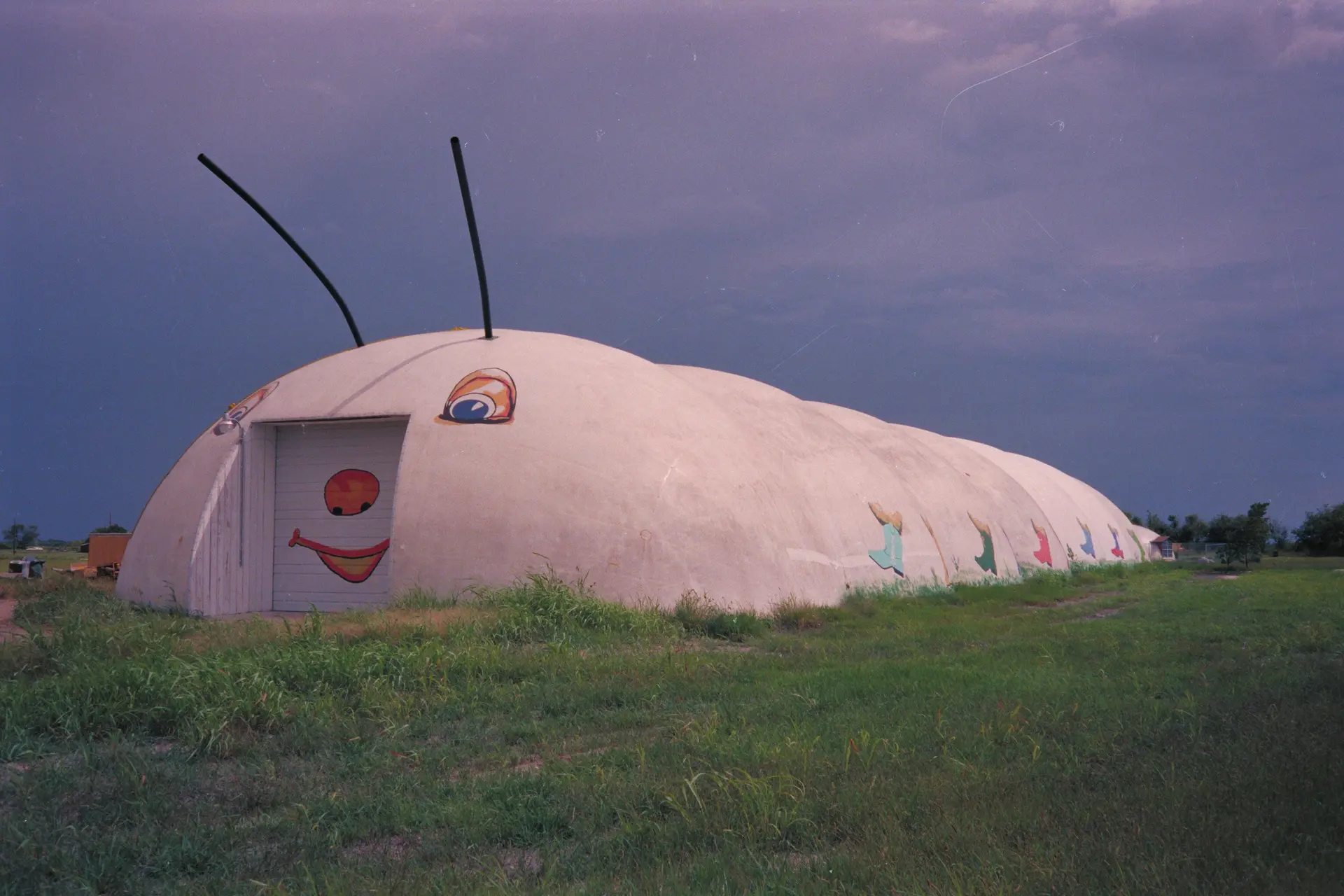
Bruco’s seven 60-foot interconnected domes form a 14,000-square-foot manufacturing plant where Monolithic designs and fabricates Airforms and other fabric structures. The overall size is 60 feet wide by 240 feet long by 20 feet tall.
Not a typical factory
With its flirty eyes, smiley mouth and cowboy boots that glow in the dark, Bruco, our manufacturing plant in Italy, Texas, looks nothing like a typical factory. But while Bruco might look like a playful, giant caterpillar on the outside, it’s serious work on the inside.
From the beginning, Monolithic has fabricated more than Airforms for Monolithic Domes. We have built hundreds of methane digester covers, condensate ceilings, compost covers and more. The caterpillar is large enough to accommodate the construction of an Airform for a 300-foot diameter Monolithic Dome or a grain tarp to cover a two-acre grain pile.
Bruco’s seven, 60-foot, interconnected domes encompass 14,000 square feet of factory space, housing a state-of-the-art, laser-guided, 200-foot-long RF welder that heats and seals fabric pieces using high-frequency electromagnetic energy, computer-guided cutting machines, and various industrial sewing, grommet, and sealing machines.
Monolithic can design and construct virtually any fabric form. Event planners, playground and park designers, athletic directors, fracking companies, wastewater treatment plants, agricultural research and development organizations and many more groups and people use architectural textiles. We can help any of these groups achieve their goals. We can develop prototypes or go directly to mass-producing any custom fabric form.
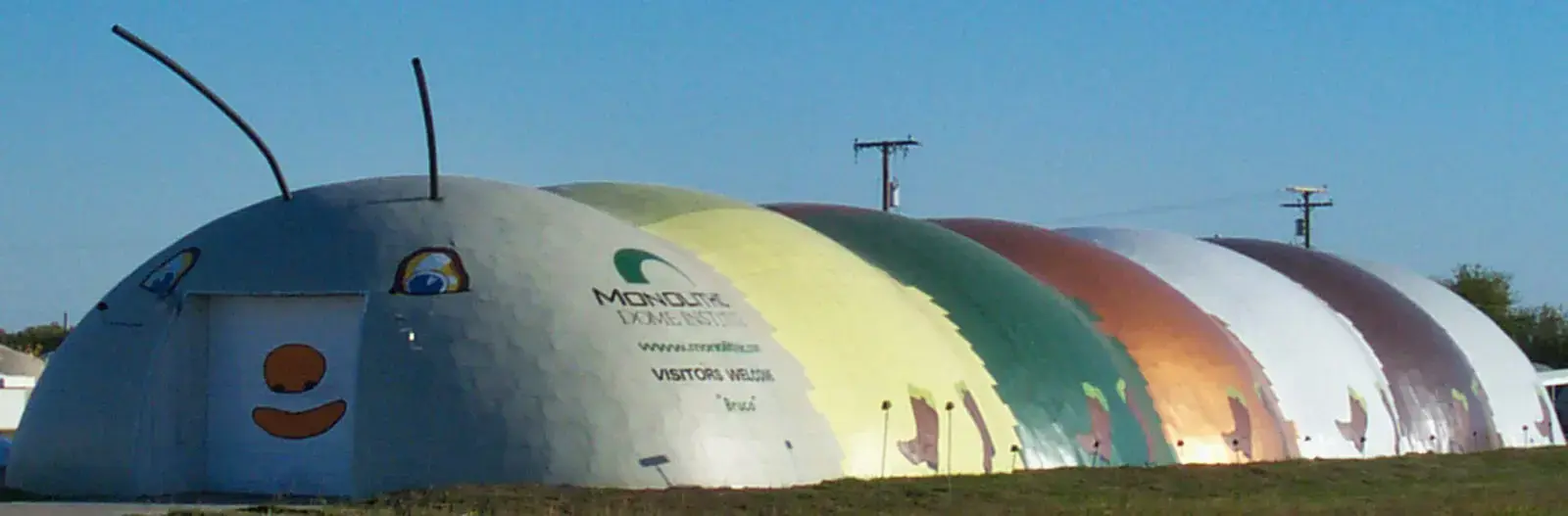
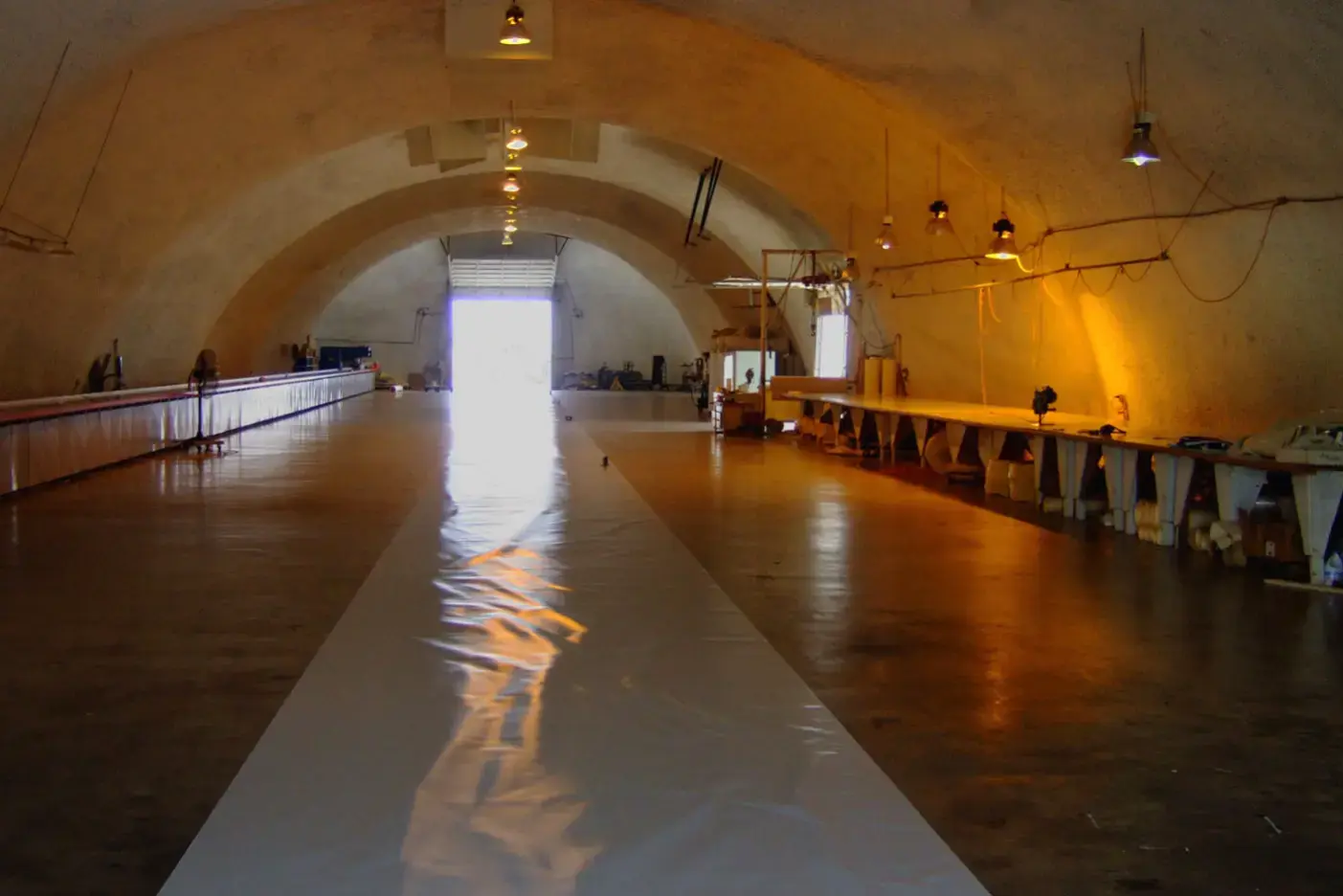
[Left] In Summer 2001, Bruco got a makeover and now has a multi-colored coat. [Right] The caterpillar provides room for the manufacture and assembly of Monolithic Dome Airforms up to 300’ in diameter, grain covers for multi-acre grain piles, fabric forms for methane digesters, pond liners, compost covers and more.
Airforms and More
While the manufacture of Airforms for domes remains the main part of what goes on inside Bruco, other fabric structures are also made.
David B. South said, “We build a lot of tarps. Many are just like a flat sheet that might be used to cover a tennis court. But many are quite specialized. These include grain covers, condensate ceilings, membranes for methane storage tanks, diaphragms for water tanks, tension tarps and pond liners.”
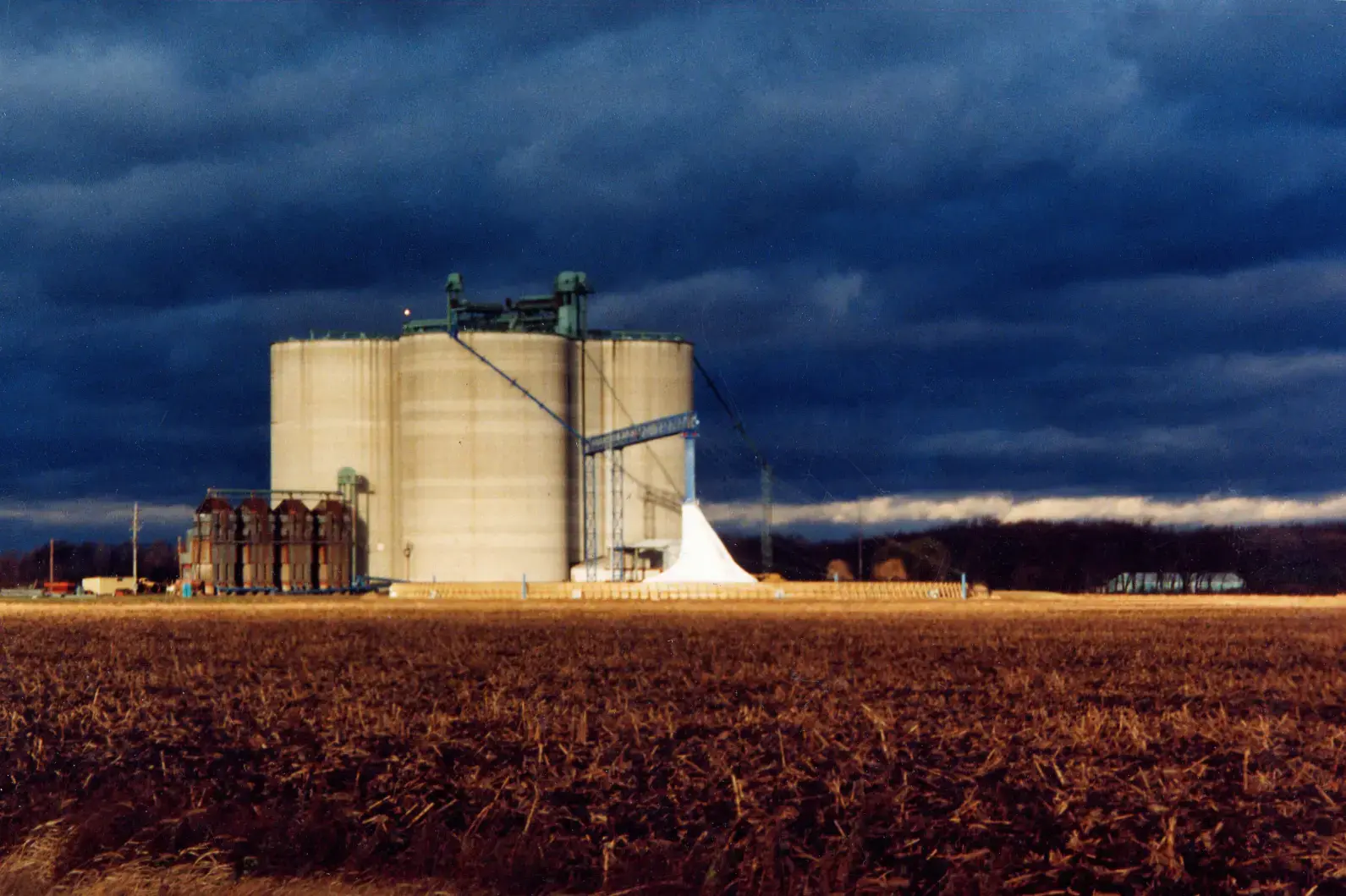
The grain cover is assembled and ready to start receiving grain. The center tower supports the grain conveyor that fills it. Grain drops through the center tower and under the cover.
Grain Covers
Protecting their harvest is a major concern of large, grain-growing corporations as well as small, independent farmers.
South said, “Customers who store huge piles of grain outside must keep it out of the wind, rain and sun. So they cover it with a cone-shaped, fabric tarp. The customer tells us how big the grain pile will be, and we build the cover. We use the same tough polyester fabric as our dome Airforms, but in a lighter weight and always white, since white reflects sunlight.
"Often,” South continued, “those covers are so large they are shipped in pieces - 12 to 15 pieces that are bolted together by the customer in the field. Some enclose piles 300 feet in diameter and 70 feet high, or an area of 1 ½ acres.”
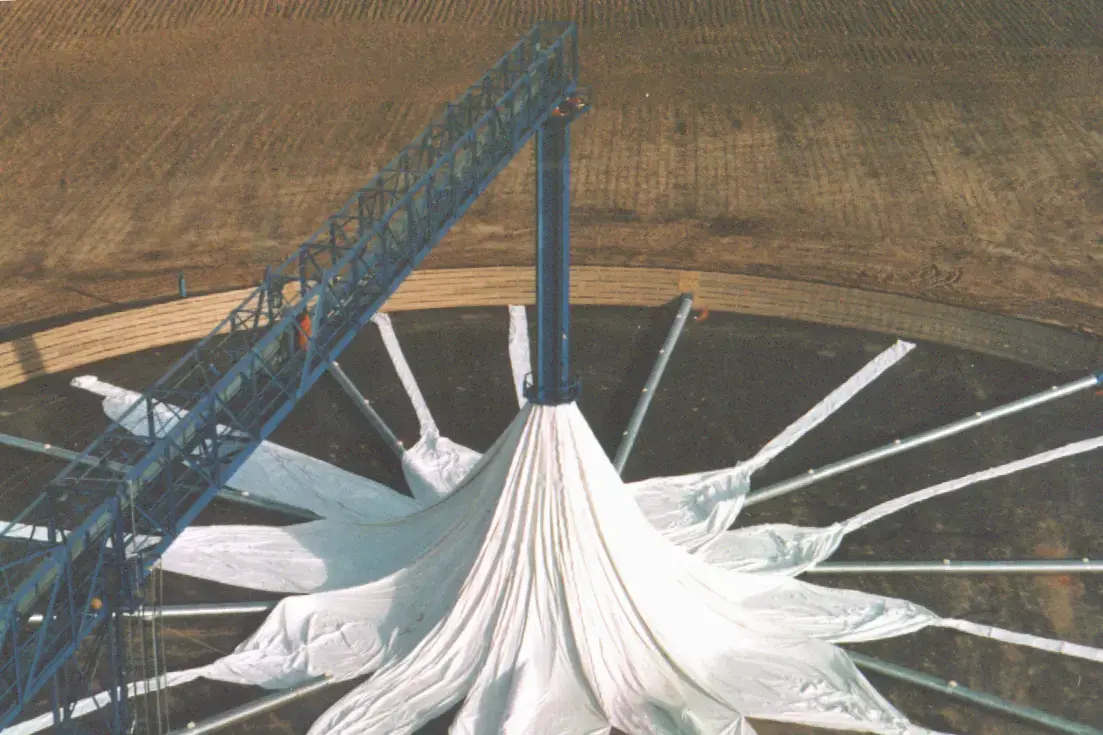
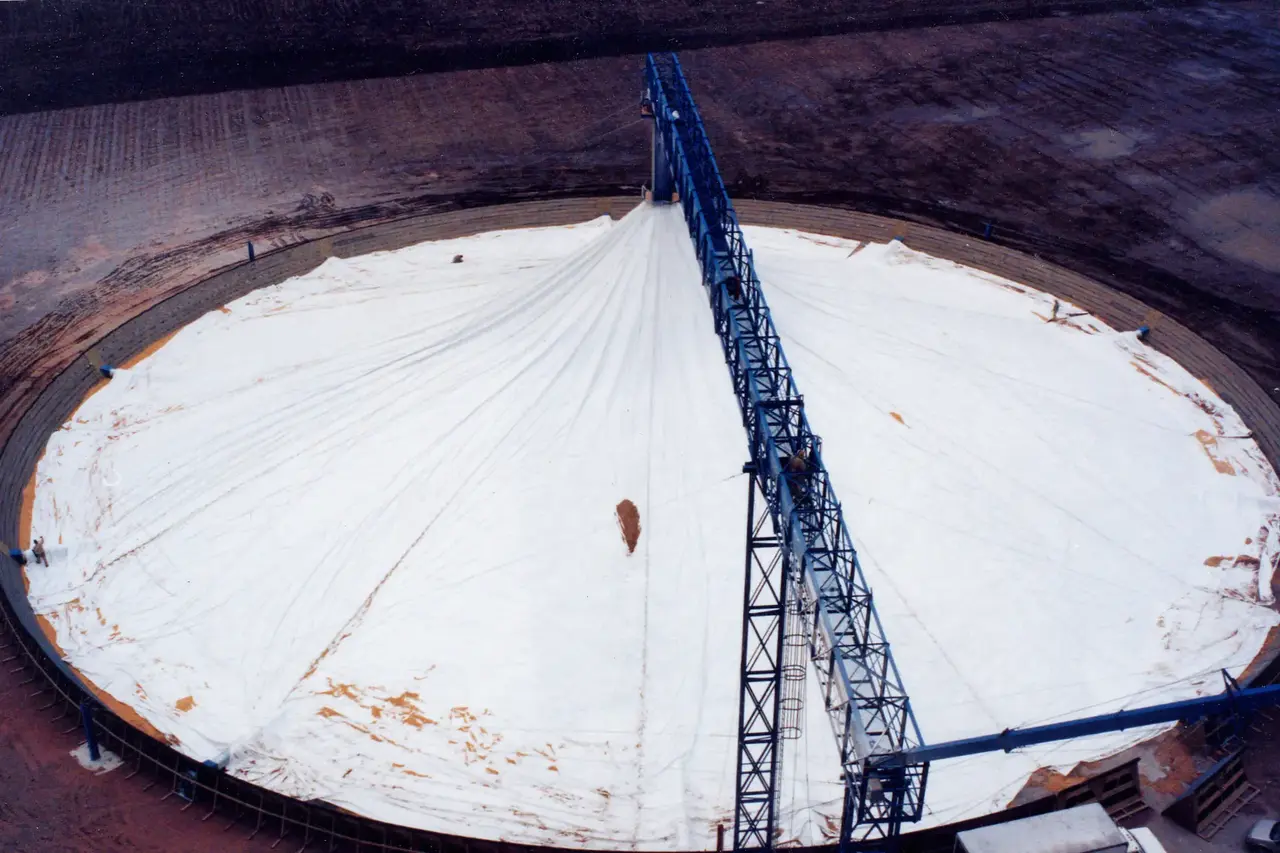
[Left] Each gore or section of the grain cover is fastened to a lifting ring around the center tower. As the lifting ring rises, the gores attach to each other [Right] Grain is spread to the edges, forming a weather-tight storage.
Usually, a wooden fence about 4 feet high encloses the grain storage area. A tower topped by a head house stands in the center of the fenced area. The middle of the grain cover fits around the tower, while its bottom is secured to the fence.
As grain begins to pile up beneath it, the cover rises, ultimately forming a cone-shaped fabric structure. Blowers connected to the structure pump fresh air under it in calm weather. But if a storm arises, the blowers suck out the air and make the tarp into a tight shield over the grain.
Don Garrison, manager of Monolithic Airforms Manufacturing, said, “The life of a tarp really depends on what it’s exposed to, but most last about seven years. Large grain growers usually have a replacement schedule - they replace a certain number of sections every four years.”
Johnson System, Inc., a company that designs permanent and temporary grain storage systems for major co-ops and elevators, such as Central States Enterprises, has also purchased Monolithic grain covers. President Howard Johnson said that Monolithic products are often used in the company’s Quality Pile System, round units with a seven- to ten-year lifespan. They have a capacity of 500,000 to 3,000,000 bushels, use bolt-up tarps electrically winched, and have a tunnel reclaim system.
In addition, Johnson’s Standard Pile System often includes pull-over tarps manufactured by Monolithic, which are installed after filling.
Asked about product satisfaction, Johnson said, “You folks (Monolithic) produce a high-quality, longer-life type of tarp. We like it.”
Condensate Ceilings
Communities that use elevated, steel water tanks sometimes build the tanks over offices or equipment storage sheds.
“So they need a condensate ceiling to fit under the tank,” South said. “Moisture forms on the outside of the tank and drips down. The condensate ceiling, made from our polyester fabric, acts like a diaper, collecting the liquid. It’s cut to an exact size and attached under the tank with special hooks. You can’t see it because it’s covered by a metal skirt over the tank’s legs. We make a lot of those each year for several companies.”
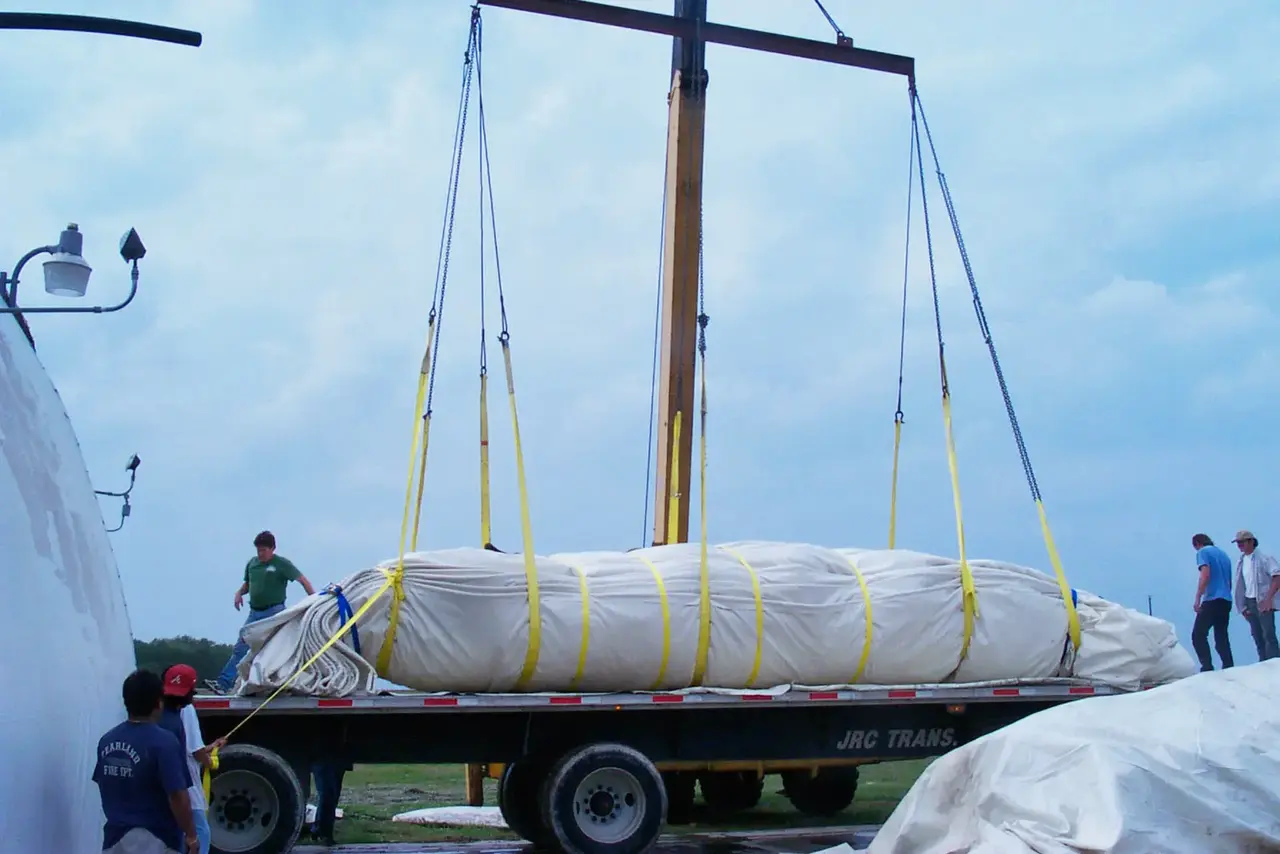
Don Garrison, Airform Division Manager, and workers use a crane to load a 265-foot half-sphere Airform created for Hovensa, a coke storage facility in St. Croix U.S. Virgin Islands.
Methane Storage Tank Membranes
Some sewage treatment plants use huge concrete tanks, sometimes lined with rocks, into which raw sewage is pumped. Bacteria living in the tanks digest the sewage and, in the process, produce methane. If treated properly, that methane can be used to run generators. But if not treated properly, obnoxious odors and an unclean atmosphere will develop.
At Bruco, Monolithic Airforms manufactures membranes for methane storage tanks. Two such membranes, an outer one that is always kept inflated and an inner one that rises and falls with the amount of methane beneath it, effectively control odor and protect the environment.
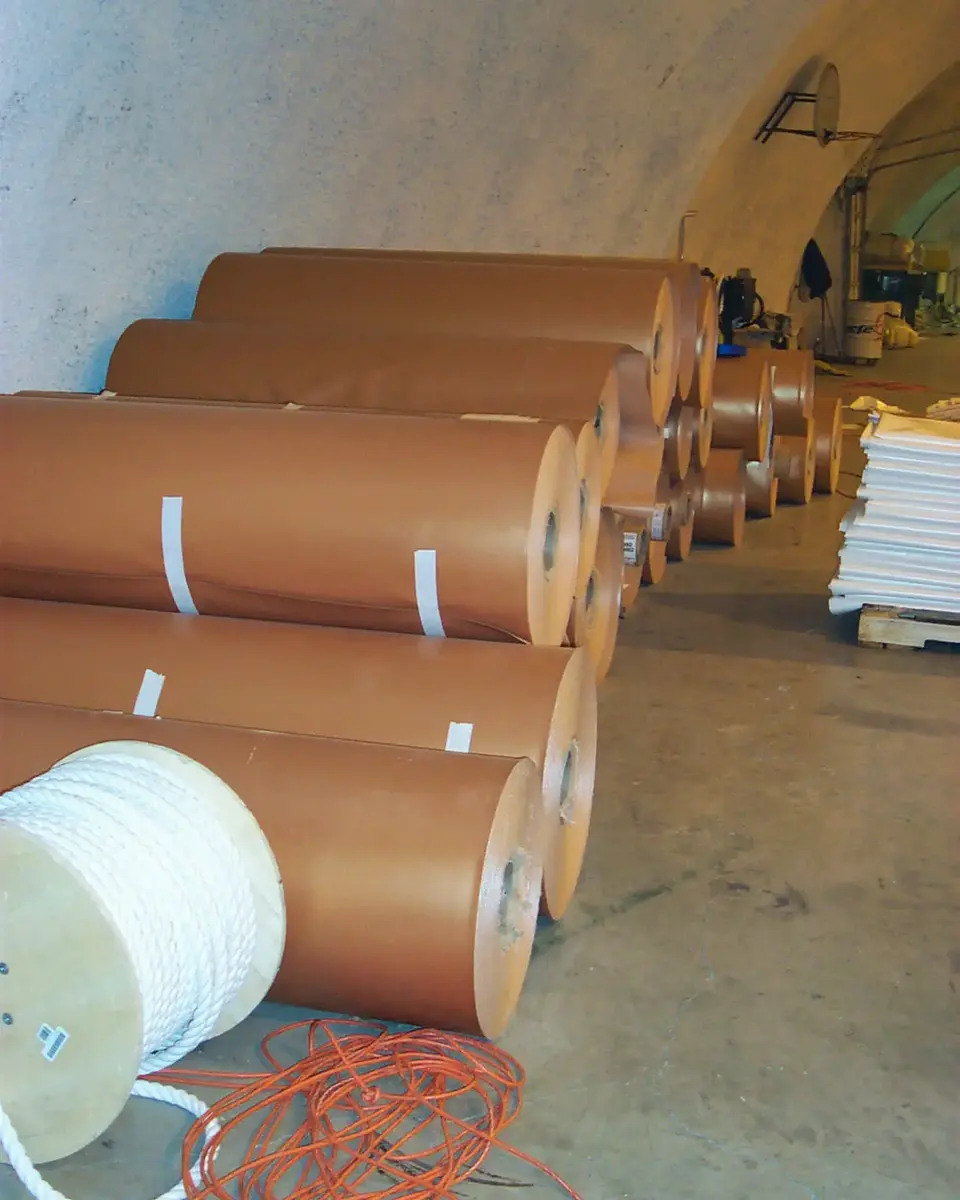
Monolithic has special fabrics shipped to Bruco from all over the world. The caterpillar has plenty of room to store the massive rolls.
Water Tank Diaphragms
“Approximately one of every 50 large, multistory office buildings in the U.S. has a water thermal storage system,” South said.
North Park Central in Dallas is one such facility. It has two huge water thermal storage tanks, each with a diaphragm manufactured by Monolithic Airforms. The diaphragms are designed and shaped so they can rise to the top of the tank or sink to the bottom, depending on the water temperature.
“Water has a property called thermocline,” South explained. “That means that water stays in temperature layers, with the warmest at the top. So during the day, as the tank fills with warm water, its diaphragm sinks.
But at night, when electricity is at its cheapest, that water is run through a chiller, and as it chills and re-enters the tank, the diaphragm rises. By morning, the diaphragm is at the top, and the water is ready to circulate through and cool the building.”
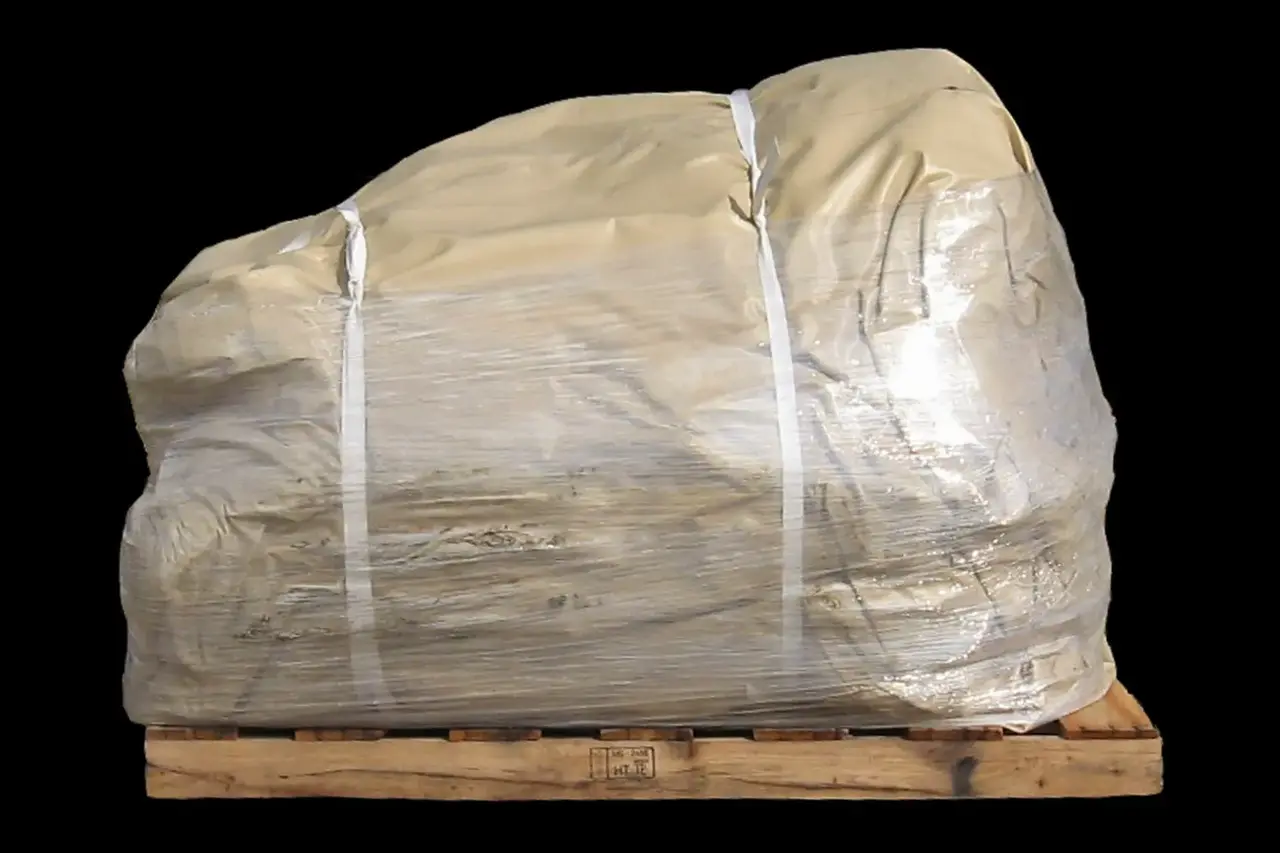
The shipment process includes carefully folding the Airform or other fabric structure and wrapping it with scrap fabric and shrink wrap.
Tension Tarps and Pond Liners
Inside Bruco, Monolithic also makes specialty tension tarps and pond liners made from polyester vinyl fabric.
Tension tarps are covers shaped to exactly fit an elaborate, very expensive machine or piece of equipment. Because the tarp conforms around angles, it provides maximum protection from the elements.
A tension tarp was recently purchased by the SOAR Project, which is assembling a huge telescope atop a mountain in Chile. SOAR covered their construction site with the tarp. It protects the workers, their equipment and the fragile telescope parts from 50-mph winds.
Pond liners manufactured by Monolithic Airforms are most often used to prevent chemically treated water in recreational pools from disappearing into the ground. But such liners are also sometimes used to prevent dangerous substances, such as arsenic, from leaching from the ground into the water. In either case, the nonporous polyurethane used for these liners does the job.
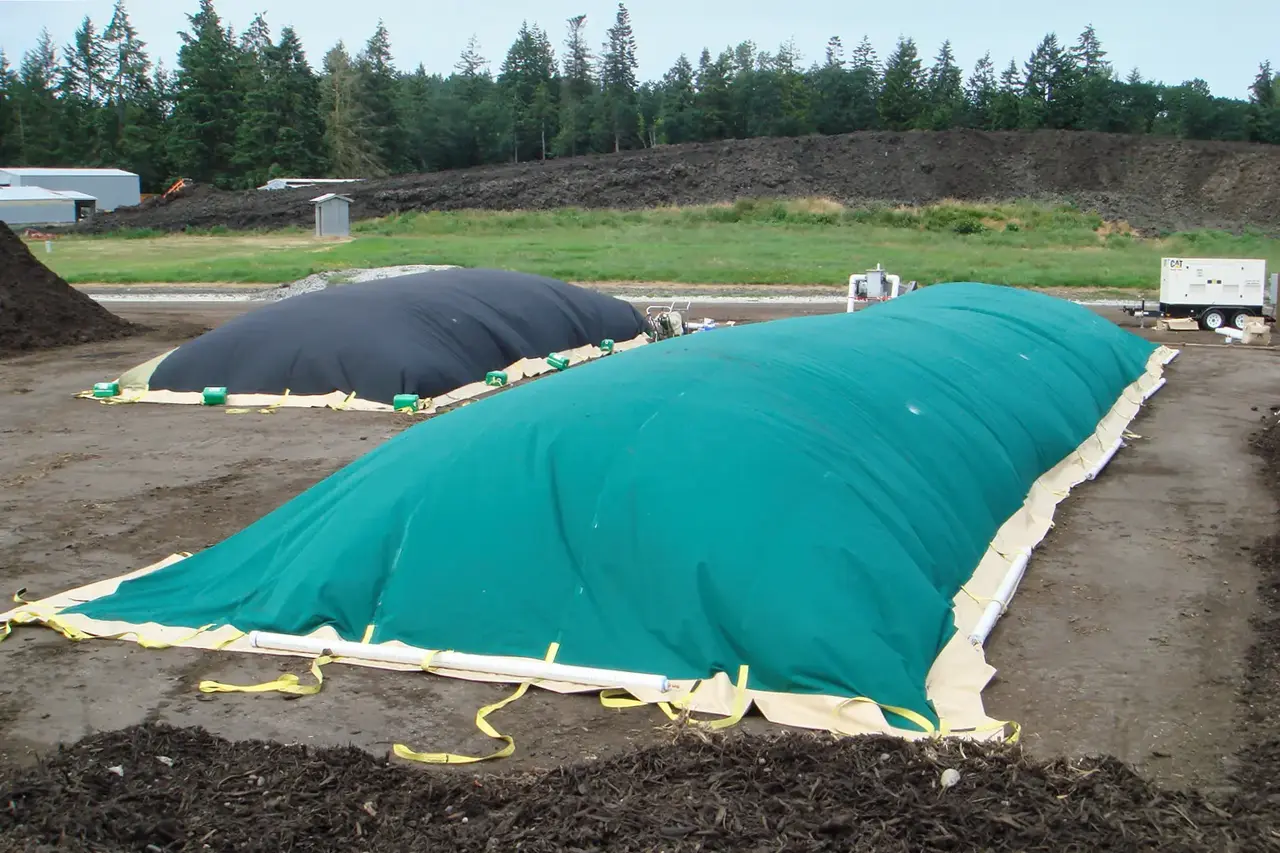
Manufactured in Bruco, these compost covers create an odor free option for the composting industry and home composters alike.
Compost Covers
Inside Bruco, Monolithic designs and manufactures Odor Free Compost Covers (odorfreecompostcovers.com) to fit a client’s specific needs. The needs can range from those of an amateur gardener striving to be more green to a city administration solving waste management problems.
We make the covers of a high-grade, moisture-proof, specialty fabric that confines offensive odors but lets water vapor and normal air molecules escape. Such a cover allows and promotes the biodegrading of organic matter into a usable, recyclable soil aid in a very short time.
The Odor Free Compost Covers are made for and sold exclusively by MOR, Inc.